Comfort Homes 24
HVAC service across Greater Sacramento. The website had to stop losing enquiries.
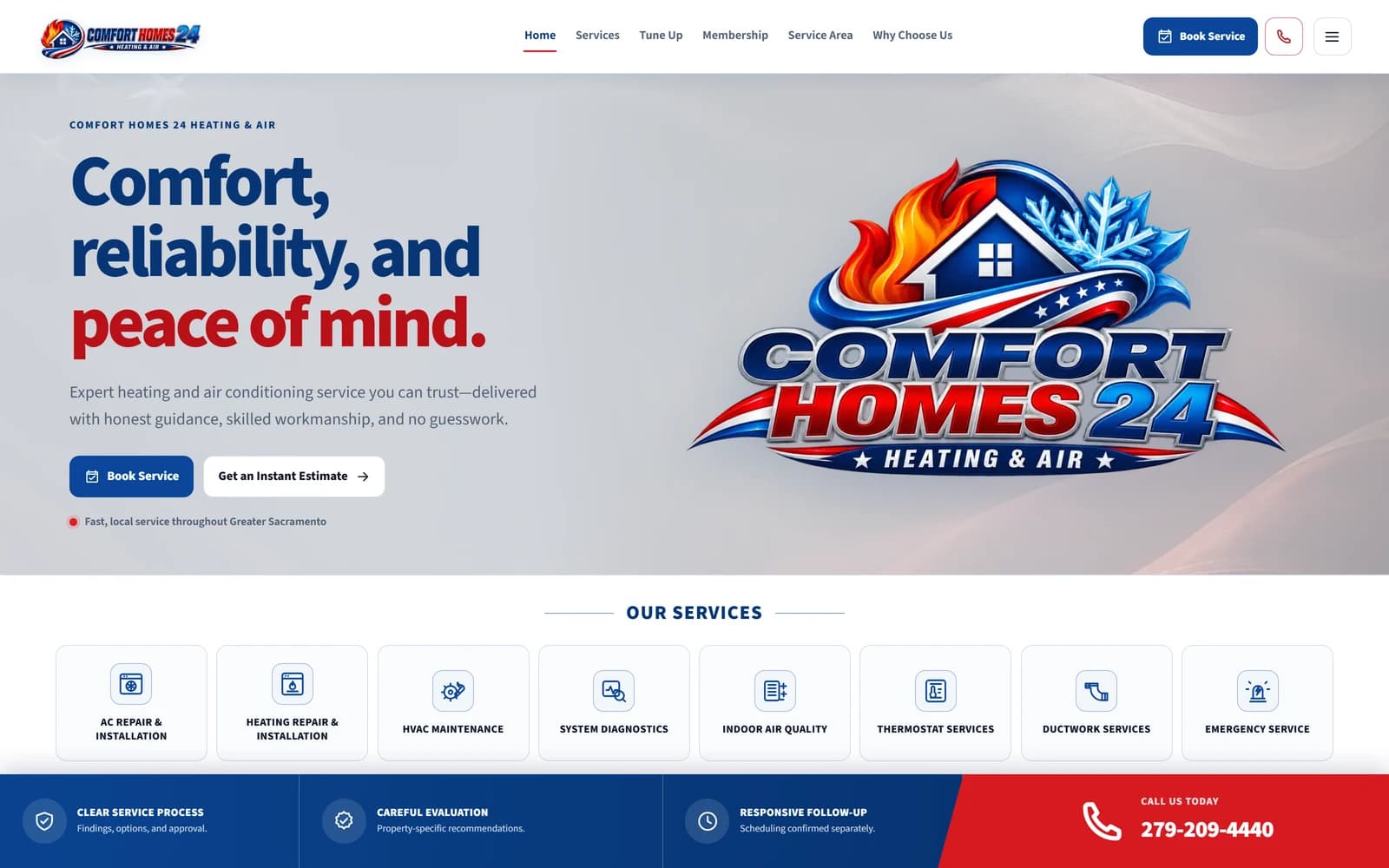
Real desktop capture of comforthomes24.com, taken . Activate live preview to load the site itself.
Comfort Homes 24 provides heating and air conditioning service across Greater Sacramento — repair, installation, maintenance, diagnostics, indoor air quality, and emergency callouts.
A client project, not a business I own. The brief was commercial rather than cosmetic: the site needed to convert the people already searching, and stop losing the ones who called.
Home-services customers rarely know what they need. They know a symptom — the AC is not working, the heat is out, the bill is too high. A conventional service menu asks them to self-diagnose before they can act.
Meanwhile every enquiry that arrived by phone had to be written down, priced, scheduled, and remembered by a person. That is where the losses were, not in the design.
Lead with the symptom, not the service. A triage entry point in the customer’s own language routes them to the right service, and the booking and estimate flows capture everything the office used to write on a pad.
- Symptom-based triage: “My AC isn’t working”, “I’m not sure”
- Book Service and Get an Instant Estimate as parallel paths
- Service, membership, tune-up, and service-area pages
- Enquiry routing with SMS confirmation and follow-up
- Local search structure for Greater Sacramento
A website was the smallest part of it.
The visible site is one layer. The routing and automation behind it did the commercial work.
Mapped how enquiries actually arrived and where they died. The triage concept came out of that, not out of a design trend.
Services, membership, tune-ups, and service area organised so a first-time visitor lands in the right place in one click.
Worked with the existing mark and built a clear, high-trust visual system around it. Legibility over fashion.
Two parallel primary actions — book, or get an estimate — plus a plain-language triage for everyone who cannot choose.
The site, the forms, the estimate logic, and the routing layer that decides where an enquiry goes.
Confirmation, routing, and follow-up without office staff retyping anything.
Service-area structure and page architecture aimed at the searches that actually convert.
Where the enquiries were going.
A service business does not lose customers on price. It loses them in the gap between someone deciding to call and someone answering. Every step below used to be a phone call or a sticky note.
Visitor picks what is wrong in their own words rather than choosing a service code.
AUTOMATEDTriage maps the symptom to the correct service and urgency.
AUTOMATEDBooking or instant estimate collects property details in one pass.
AUTOMATEDSMS and email confirmation immediately, scheduling confirmed separately.
AUTOMATEDResponsive follow-up on quotes and completed work, on a timer.
AUTOMATEDFor the technical reader.
- FRONTEND
- Next.js · React · Tailwind
- BACKEND
- Node · Postgres · form and routing layer
- INTEGRATIONS
- Twilio SMS · Resend · Google Business Profile
- INFRASTRUCTURE
- Vercel · managed Postgres
- SEO
- Service-area page structure, schema markup, local landing pages
Only the parts worth showing.
Marked slots below — drop in real screens, admin captures, or diagrams and this section carries the case study on its own.
Enquiries arrive structured and acknowledged instantly, and nothing depends on someone remembering to write it down.
Published performance figures are being measured properly before they go on this page. When there are numbers worth defending they will appear here — sourced and dated.
- Deployment
- Live
- Enquiry acknowledgement
- Automatic
- Manual re-entry
- Removed
- Published metrics
- Client-held
Losing enquiries between the phone and the calendar?
This is the most common problem I fix, and it is rarely a design problem. Tell me how enquiries reach you today.
5SHIRY · CH24-01 · CLIENT / SELECTED WORK/work/comfort-homes-24